


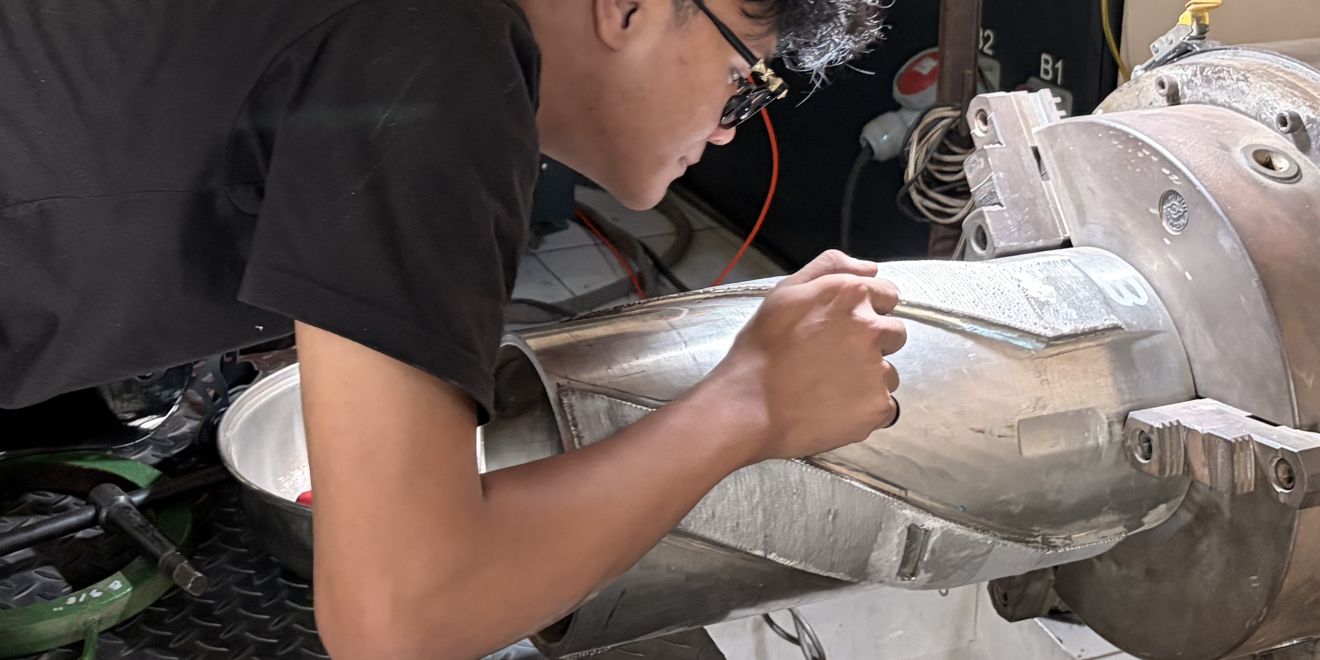
A drill component stuck downhole does not just cost money — it stops the entire operation until it is removed. The industry's answer has been hardfacing: protecting wear-critical surfaces before failure happens. Laser cladding delivers that protection with a level of dimensional control and heat discipline that conventional hardfacing cannot match. At Fotonix, we have applied this to drilling components repeatedly, and the results hold.
When standard hardfacing is not enough
Conventional hardfacing — stick weld overlays, MIG — is cost-effective for components where precise geometry is not critical. But for precision wear surfaces, the problems compound: multiple layers cause excessive buildup, and heat drives contaminants into the weld pool. Dimensional tolerances become difficult to hold. Post-process machining on a tungsten carbide surface is painful work — WC is hard enough to resist exactly that. The correct answer is to get the dimension right the first time.
Why dimension matters more than hardness alone
Laser cladding typically requires only about 0.5mm of cleanup per side after hardfacing — significantly less than what PTA and TIG processes demand. That reduction is not cosmetic. It means less WC material ground away, less time in the machine shop, and a final dimension you can trust. The localised heat input from the laser also results in minimal dilution of the base material — protecting the structural core of the component through the entire process. And because heat input is controlled, the risk of distortion and cracking in the base material is kept to a minimum — which matters when the component geometry must be preserved for reassembly.
Restoration of Drilling Sleeves
The drill stabilizer sleeve sits in continuous contact with the borehole wall. It absorbs abrasion, impact, and corrosive drilling fluid across every metre of the string's run. When the wear surface degrades past tolerance, the options are replacement or restoration. For a component of this geometry and material cost, restoration is almost always the more rational choice — provided the process can hold dimension and bond integrity across repeated cycles.
We have restored drill stabilizer sleeves and drill bits for oil and gas service companies. The material stack we apply depends on the wear environment: Inconel 625 as a corrosion-resistant base layer, followed by a tungsten carbide top layer for abrasion resistance where the surface contacts formation. Three layers of Inconel 625 before the WC coat is a configuration we have run and verified. We have done this on multiple units.
Beyond tungsten carbide
WC is the standard, but it is not the only option. Stellite 6 — a cobalt-chromium alloy — offers an excellent combination of wear, corrosion, and heat resistance, and is well established in oil and gas and rotating equipment applications. Rockit 401 is another material we work with regularly, offering high hardness with good impact resistance for demanding wear surfaces. The right choice depends on the specific load, temperature, and corrosion conditions of your component.
All powder materials we use are sourced from reputable manufacturers including Oerlikon Metco, Höganäs, and Continuum Powders. If your component has worn surfaces and you are not certain which hardfacing material is appropriate, that is the right conversation to start with us.