


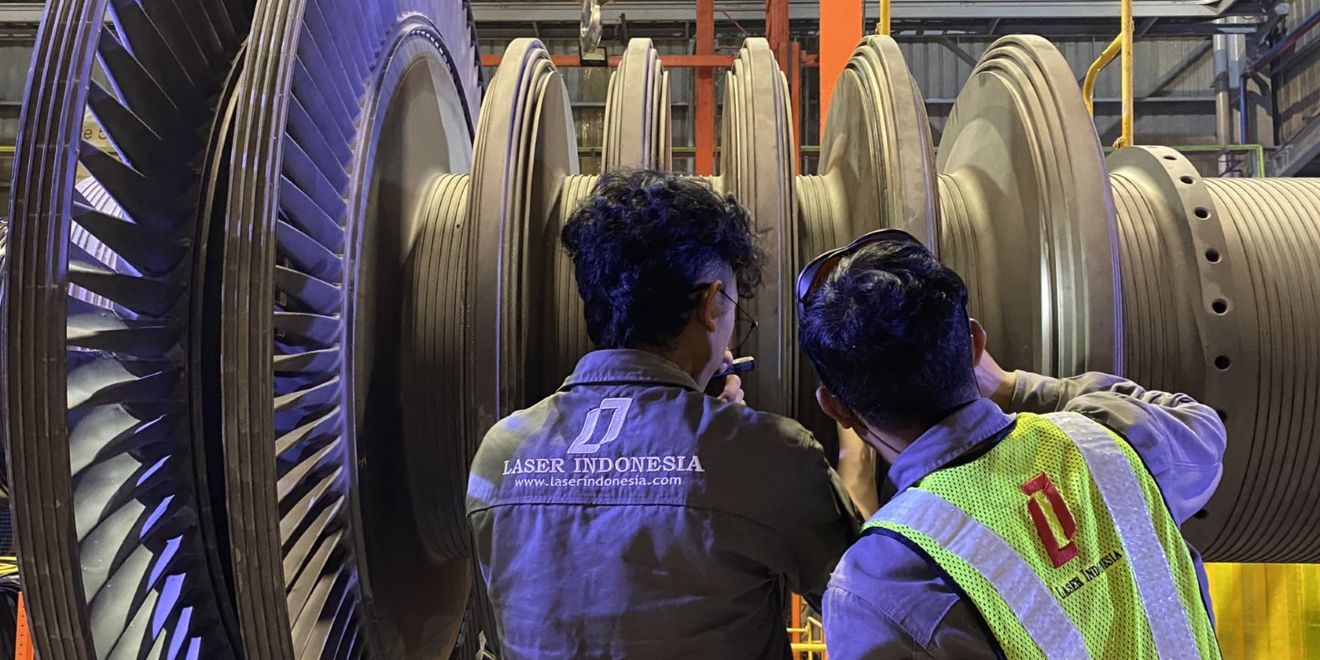
A shutdown that runs over schedule because of delayed welding — or worse, components distorted by the welding process itself — is a problem we hear about too often. Laser cladding completes the same work in hours or days, with a fraction of the distortion risk. And the result is not simply a repaired component — it is one that is more wear-resistant and more corrosion-resistant than it was originally.
Shorter shutdowns. Less risk.
You may have been through this before — a shutdown that should have finished on time, delayed because the welding work fell behind. Or worse: significant distortion after welding, which created more work rather than resolving it.
Laser cladding completes the welding process in hours or days, with substantially lower distortion risk than conventional methods. And with the right material choice, your component can leave the workshop more wear-resistant and corrosion-resistant than its original condition.
One example: Inconel 625 cladding applied over AISI 4340 base material on a turbine journal. Inconel 625's combination of high corrosion resistance and maintained mechanical strength at extreme temperatures means a restored turbine journal can outlast the original.
One process. A wide range of critical components.
We have worked on critical components across power generation systems — both rotating components under dynamic load and static components under sustained thermal and mechanical stress:
Rotating components: rotor shafts and turbine shaft rotors — primary turbine shafts with wear at journal bearing surfaces and seating faces; coupling mops and spigots — including Mitsubishi turbine units — with wear at contact surfaces and seating dimensions; LP rotor discs — low-pressure turbine discs with tight geometric tolerances; LP turbine discs — energy conversion components sensitive to mass change and balance; impeller eyes and impeller shafts — pump components supporting power generation systems, susceptible to cavitation and corrosion; pump shafts — support pump shafts with worn bearing surfaces from extended operation.
Static and semi-static components: turbine casings — turbine housings with erosion and wear at sealing and seating surfaces; blade tenons and blade vanes — components that determine energy conversion efficiency, highly sensitive to geometric change; blade diaphragms — static blade carriers requiring high-precision restoration of flow profiles; gland packings — turbine seals with tight clearance tolerances to prevent steam leakage; bearing houses NDE — non-drive-end bearing housings that determine shaft alignment; dry seal gas — mechanical seal components in gas turbines and gas compressors; oil deflectors and torque tubes — ancillary components of lubrication and torque transmission systems.
Every component presents a different challenge. We begin each job with an in-depth discussion with you to select the right method and material.
The right tool for each job.
Over the years we have built a capable arsenal for handling your critical components: KUKA robotic arm-controlled laser cladding, robotic laser welding for precision work, handheld laser welding for areas that cannot be reached by machine, and laser micro welding using the Orlaser system with an IPG 250W QCW source for work demanding the highest precision.
Depending on component geometry and condition, we choose the most appropriate approach — whether that is the KUKA robot moving over a stationary component, the component rotating on a positioner while the robot holds position, handheld laser for tight areas a machine cannot reach, or Orlaser micro welding for repairs where precision is absolute.
Where automation still has limits, we have our most reliable tool: a skilled welder with a handheld laser or pulsed TIG for finishing steps where no machine can substitute. All of this, in the service of the best possible result — for work that has no tolerance for anything less.
A bond that holds because it has to.
The advantage of laser cladding is not only in the filler material — it is in the precise heat control maintained throughout the process. Tightly controlled heat input produces a shallow fusion zone of 0.1–0.3mm: deep enough to form a structural metallurgical bond, without altering the properties of the base material beneath. The same control produces very low dilution — meaning the cladding layer reaches its intended composition faster, with fewer layers than conventional methods require.
Our process follows a consistent workflow: component condition inspection, surface preparation, preheat before cladding, the cladding process itself, NDT, then joint inspection with you. Post-weld heat treatment is available where material specifications or client requirements call for it. The workflow can be adapted to your specific requirements.
Quality monitored throughout — not declared at the end.
We perform NDT not because it is asked of us — but because we want to know for ourselves whether the work is correct. Our in-house certified NDT team is deployed throughout the process: before cladding to understand the starting condition, during the process to catch anomalies early, and after machining to confirm the final result is clean and free of cracks or porosity.
This is not a formality. It is how we hold our own standard — without you needing to ask for it.
You are always welcome to bring your own inspection team. We have no objection to that — quite the opposite. Because we already know the result is good before they arrive.
Qualifications set by the work, not the wall.
Equipment is only as good as the people operating it. We require our welders to hold BNSP certification before they work on a client's component. For work that falls within the scope of oil and gas inspection, Migas certification is the minimum standard we apply. These are the qualifications the work requires.
Not for every case — but possibly for yours.
Laser cladding is not a universal solution. Some geometries are not suited to it; some base materials require deeper assessment before we can recommend it. We are straightforward about this from the beginning — because a restoration that fails in the field costs far more than a decision made with complete information.
If your component is on the list of what we handle — or even if you are not certain whether restoration is the right path — let's talk. We will start from the actual condition of your component.